




Cement makers plan ₹13,000 crore green-power push as energy costs take centre stage
 Samrita JosephSeptember 10, 20262 Mins read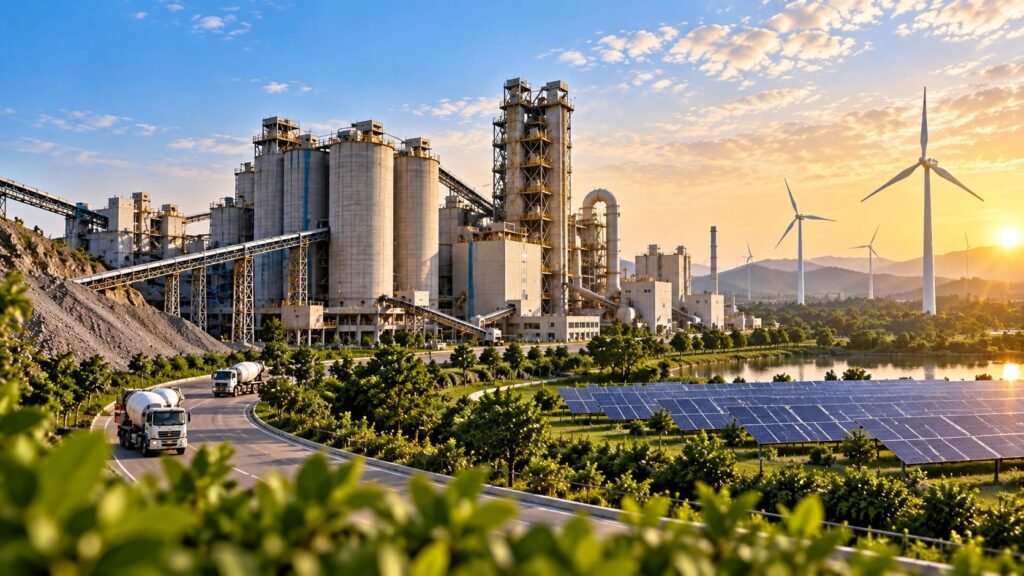
Cement makers plan ₹13,000 crore green-power push as energy costs take centre stage
India’s leading cement manufacturers are stepping up investments in green power, with the industry expected to commit ₹12,000–13,000 crore over the next two years to expand renewable energy capacity.
The planned investments could take the sector’s cumulative green-power capacity to about 5.8–6.0 Gigawatts by March 2028, compared with around 4.0 Gigawatts in March 2026. UltraTech Cement, Ambuja Cements and Dalmia Bharat are among the major companies driving the broader shift towards captive renewable power.
The move is increasingly being viewed not just as a sustainability initiative, but as a way for cement producers to protect margins from volatile fuel and electricity prices. Power and fuel account for a significant share of cement manufacturing costs, making renewable energy an important lever for companies seeking greater cost stability.
Industry estimates indicate that replacing conventional energy with green power by every five percentage points could lower fuel and power costs by around ₹15–16 a tonne. At a 25% replacement level, operating margins could potentially improve by 140–160 basis points, supported by unit cost savings of about ₹75–80 a tonne.
UltraTech Cement has already made considerable progress on this front. During the first quarter of Financial Year 2026–27, green power accounted for approximately 47% of the company’s total energy requirements. The company also reported a 17.2% year-on-year increase in consolidated net profit to ₹2,604 crore during the quarter.
For the wider cement industry, the transition is likely to involve a combination of renewable power projects and waste heat recovery systems. The economics are particularly attractive for large producers that have the financial capacity to invest in captive energy infrastructure at scale.
The planned additions could generate annual cost savings estimated at ₹6,200–6,700 crore, with an expected payback period of around 1.8–2.2 years. This could further widen the cost advantage of larger cement companies over smaller producers with limited capital available for renewable-energy investments.
The shift also comes as the cement industry undergoes consolidation and capacity expansion. With demand from housing and infrastructure remaining important growth drivers, companies are increasingly looking at energy efficiency as a structural component of their long-term competitiveness.
However, execution remains a key factor. Delays in renewable projects, transmission connectivity, changes in open-access charges and weak cement prices could affect the anticipated benefits.
For investors, the green-power transition therefore represents more than an environmental commitment. It is emerging as a strategic cost-management tool that could reshape the competitive landscape of India’s cement industry over the medium term.
- Ambuja Cements
- captive green power
- Cement Companies
- Cement companies India
- cement industry
- cement industry investment
- cement industry outlook
- Cement Manufacturing
- cement margins
- cement power costs
- cement sector India
- Dalmia Bharat
- energy cost savings
- Gigawatts
- green energy
- green energy investment
- Green Power
- green power capacity
- Indian cement industry
- net zero cement
- renewable energy
- renewable power investment
- sustainable cement
- UltraTech Cement
- waste heat recovery






Related Articles
Kobelco Launches Three New Excavator Models in India
Kobelco Construction Equipment India has introduced the SK210, SK215LC and SK230XDLC excavators...

GKC Projects Wins ₹1,081.54 Crore Contract for Telangana Radial Road 2
GKC Projects has secured a ₹1,081.54 crore contract to build a 24.65...

Bengaluru Metro Phase 3: Karnataka Issues Preliminary Land Acquisition Notice
Karnataka has issued a preliminary land acquisition notice covering 13,409.05 square metres...


Pragati Group Plans ₹2,500 Crore Industrial Park in Andhra Pradesh’s Guntur District
Pragati Group plans to invest ₹2,500 crore in an industrial park in...

Leave a comment