





India’s Student Housing Market Emerges as a New Real Estate Asset Class
 Samrita JosephAugust 24, 20261 Mins read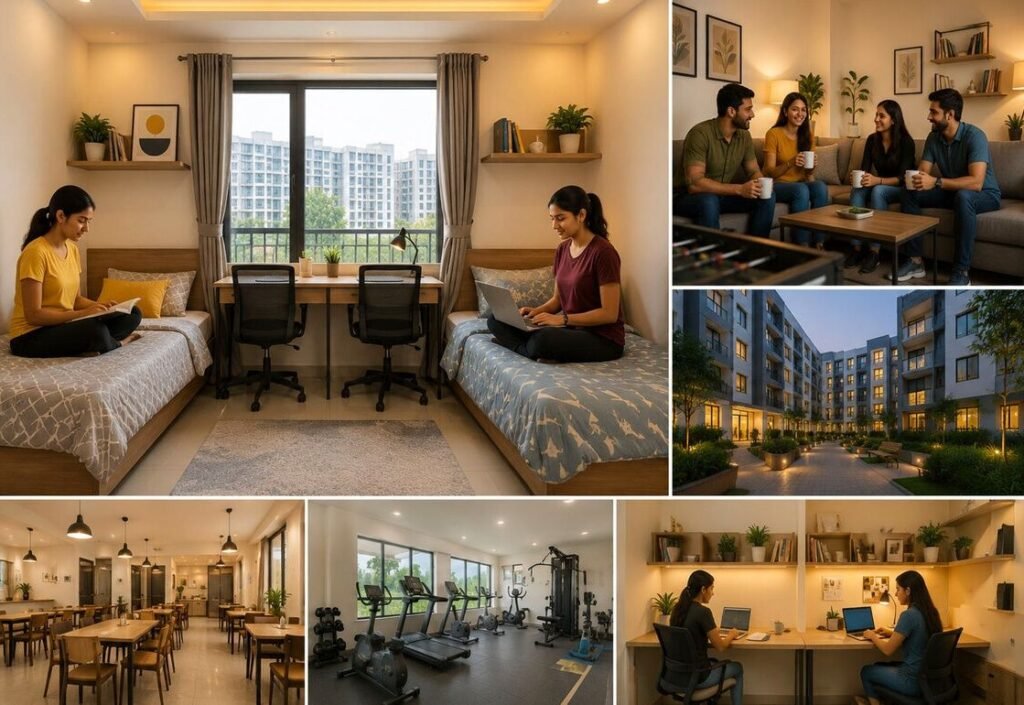
India’s student housing market is gradually moving beyond the traditional paying guest and hostel model, with professionally managed accommodation emerging as a growing real estate opportunity.
Industry estimates cited by Colliers put the demand for student-living accommodation at around 12 million beds, while organised co-living inventory is currently estimated at only about 300,000 beds. Organised supply could rise to nearly one million beds by 2030, highlighting the significant gap between demand and professionally managed accommodation.
The shift is being driven by students and parents looking for more than just a place to stay. Safety, food, housekeeping, internet connectivity, security and proximity to educational institutions are increasingly influencing accommodation decisions.
Purpose-built student accommodation, or PBSA, is gaining traction in this environment. Unlike conventional paying guest facilities, PBSA properties are designed specifically for students and typically combine furnished rooms with services and shared amenities. Gyms, study areas, recreational facilities and community spaces are increasingly becoming part of the offering.
Operators such as Union Living, Your-Space, Curated Living, Amber, Colive, Stanza Living and University Living have expanded their presence across major education and employment hubs including Bengaluru, Pune, Hyderabad, Delhi-NCR, Chennai and Mumbai.
Monthly rents vary significantly depending on location, room configuration and property quality, with industry estimates placing the range between ₹15,000 and ₹60,000. Average rentals are around ₹30,000 to ₹35,000 a month.
The limited organised supply is also beginning to attract investor attention. Professionally managed student housing can offer relatively predictable rental income while benefiting from a large and recurring demand base, particularly in cities with large student populations and established higher education ecosystems.
However, scaling the segment will not be straightforward. Finding suitable land close to education hubs remains a challenge, while regulatory frameworks for purpose-built student accommodation continue to evolve. Operators also need to balance rental affordability with the costs involved in developing and managing specialised properties.
The opportunity, therefore, lies in bridging the large supply deficit without pricing students out of professionally managed accommodation. If operators can scale efficiently and institutional investment continues to increase, student housing could develop into a more established segment of India’s organised real estate market.
- Affordable Student Housing
- co living India
- Colliers India
- India Real Estate
- Indian Rental Housing
- Organised Student Housing
- Paying Guest Accommodation
- PBSA India
- Purpose Built Student Accommodation
- real estate asset class
- real estate investment India
- Real Estate Investment Opportunities India
- real estate trends India
- Student Accommodation
- Student Accommodation Chennai
- Student Housing Bengaluru
- Student Housing Delhi NCR
- Student Housing Hyderabad
- student housing India
- Student Housing Market
- Student Housing Mumbai
- Student Housing Pune
- student living
- Student Living Market 2030
- Student Rental Market






Related Articles

Hilton Signs Two Bengaluru Airport Hotels With 600 Rooms, Opening Planned for 2030
Hilton and Kalyani Group have signed two hotels near Bengaluru airport, bringing...

L&T Realty Targets 150 Million Sq Ft Portfolio by 2031, Residential Projects to Drive Growth
L&T Realty aims to expand its development portfolio to 150 million sq...

NCC Wins ₹1,286 Crore Order for Telangana’s Radial Road-2 Project
NCC Limited has secured a ₹1,286.03 crore contract from Hyderabad Growth Corridor...



India’s Finished Steel Consumption Rises 7.5% to 84.9 Million Tonnes in H1 FY27
India’s finished steel consumption rose 7.5% to 84.9 million tonnes in April–September...

Leave a comment