





Saint-Gobain India and IIT Madras Join Hands to Set Up Two Sustainable Construction Research Labs
 Samrita JosephNovember 3, 20261 Mins read
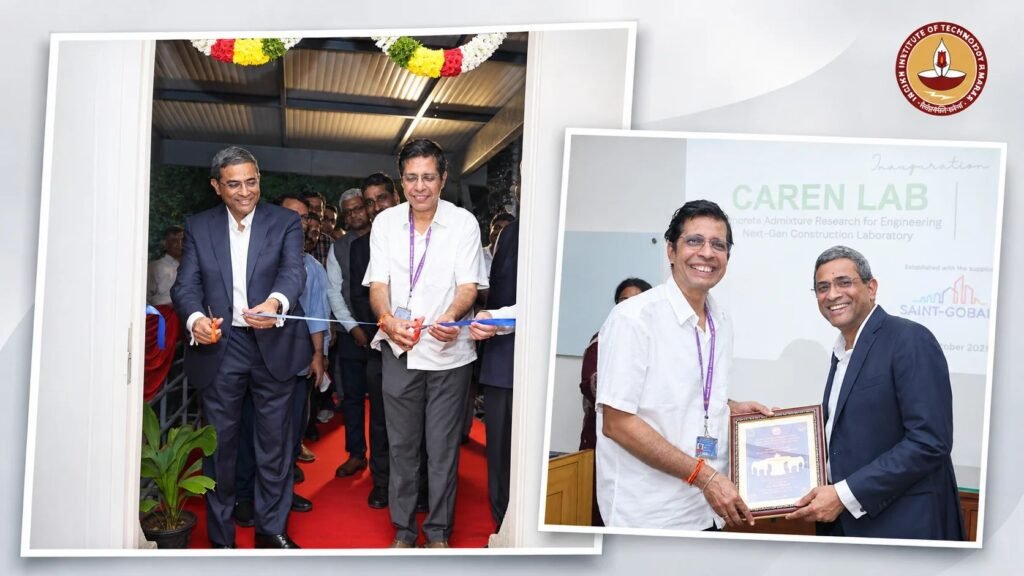
Saint-Gobain India and the Indian Institute of Technology Madras (IIT Madras) are joining forces to strengthen research in sustainable construction materials and next-generation infrastructure technologies. The partnership will establish two specialised research laboratories at the institute, backed by a grant of ₹3.8 crore over three years.
The proposed laboratories will operate under IIT Madras’ Centre of Excellence on Technologies for Low-carbon and Lean Construction (TLC2). Their work will focus on developing practical solutions to address some of the construction industry’s pressing challenges, including material efficiency, structural durability, productivity and environmental sustainability.
One of the facilities, the Digital Real-Time Sensing Technologies for Infrastructure (DRSTI) Laboratory, will focus on sensing technologies that can help monitor infrastructure performance. The second, named the Concrete Admixture Research for Engineering Next-gen Construction (CAREN) Laboratory, will concentrate on research into concrete admixtures and advanced construction materials.
The collaboration comes at a time when India’s construction sector is under increasing pressure to deliver infrastructure more efficiently while reducing its environmental footprint. Growing urbanisation, large infrastructure investments and rising demand for buildings are also increasing the need for durable, resource-efficient and lower-carbon construction solutions.
Research into real-time infrastructure sensing could help improve the monitoring of structures and support better maintenance decisions. Meanwhile, advancements in concrete admixtures could contribute to improved material performance, construction efficiency and durability.
The partnership also aims to bridge the gap between academic research and industrial applications. By combining IIT Madras’ research capabilities with Saint-Gobain’s industry experience, the initiative is expected to translate scientific developments into solutions suited to India’s construction requirements, including its hot and humid climatic conditions.
Sreedhar N., CEO for the Asia Pacific and India region at Saint-Gobain, said the collaboration would strengthen research capabilities in low-carbon materials, smart infrastructure and innovations for the built environment. He also highlighted the importance of converting scientific discoveries into practical construction solutions.
IIT Madras Director Professor V. Kamakoti said the two laboratories would strengthen the institute’s capabilities in developing next-generation construction materials and intelligent infrastructure technologies. He noted that the partnership would support the development of solutions that could benefit both the industry and the country.
The three-year research programme will focus on areas that are becoming increasingly important to India’s infrastructure development. Its progress could help expand the adoption of sustainable construction practices and encourage greater use of technology-driven solutions across the built environment.
- built environment
- CAREN Laboratory
- concrete admixtures
- construction innovation
- Construction materials
- construction research
- construction technology
- digital infrastructure monitoring
- DRSTI Laboratory
- green building materials
- green construction technology
- IIT Madras
- IIT Madras research
- India infrastructure development
- Indian construction industry
- infrastructure technology
- lean construction
- low carbon construction
- low carbon materials
- Saint-Gobain India
- Saint-Gobain partnership
- smart infrastructure
- structural durability
- Sustainable construction
- sustainable infrastructure




Related Articles

Embassy REIT Q2 Results: Revenue Rises 16% to ₹1,303 Crore as GCCs Drive Office Leasing
Embassy REIT posted a 16% rise in Q2 revenue to ₹1,303 crore,...

Puravankara Q2 Revenue Jumps 60% to ₹1,032 Crore on Strong Project Execution
Puravankara reported a 60.25% year-on-year increase in Q2 FY27 revenue to ₹1,032...

Sundaram Home Finance Q2 Net Profit Rises 20% to ₹90 Crore as Small-Town Lending Gains Momentum
Sundaram Home Finance posted a 20% rise in Q2 net profit to...



L&T Secures Significant Construction Orders for Residential and Commercial Projects in Three Cities
L&T has secured significant construction orders worth between ₹1,000 crore and ₹2,500...

Leave a comment