





Tamil Nadu Deploys India’s First 3D-Printed Artificial Reefs in Gulf of Mannar to Restore Marine Ecosystems
 Samrita JosephJune 26, 20261 Mins read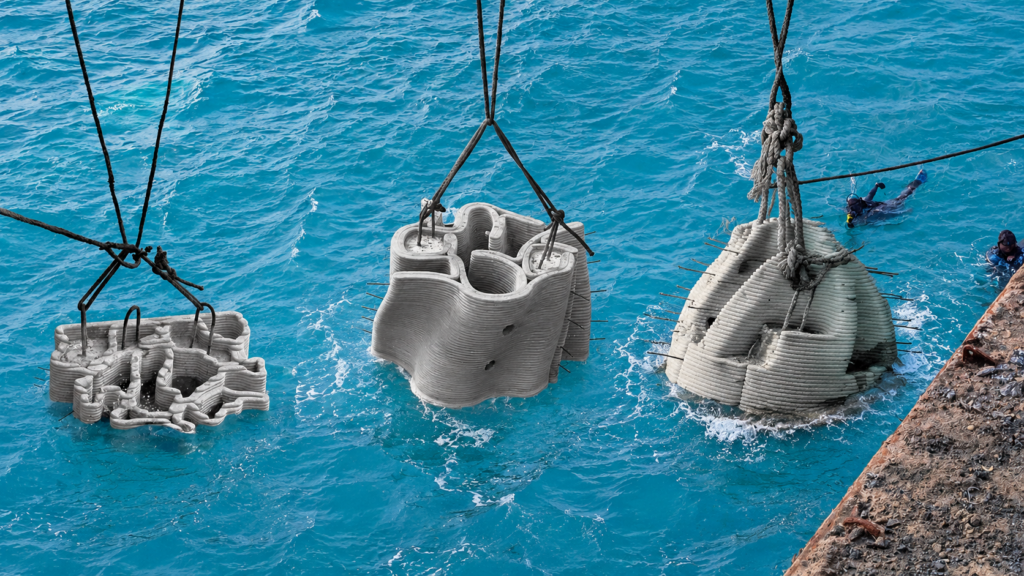
Tamil Nadu has achieved a significant milestone in marine conservation with the deployment of India’s first 3D-printed artificial reef modules in the Gulf of Mannar. The pioneering initiative has been executed through a collaboration between Chennai-based construction technology startup Tvasta and the ICAR-Central Marine Fisheries Research Institute (ICAR-CMFRI), showcasing how advanced construction technologies can support large-scale environmental restoration.
The innovative reef modules have been developed using advanced 3D-printing technology to replicate the complex structure of natural coral reef ecosystems. Unlike conventional concrete reef blocks, the new biomimetic structures feature intricate cavities, folds and textured surfaces that provide ideal habitats for corals, sponges, fish and several other marine organisms.
The project forms part of Tamil Nadu’s marine habitat restoration programme under the second phase of the Pradhan Mantri Matsya Sampada Yojana. The deployment off the Ramanathapuram coast will enable scientists to evaluate the long-term durability and ecological performance of the 3D-printed reef modules under real coastal conditions.
According to the project team, the structures are designed without conventional steel reinforcement and incorporate specialised material compositions that improve porosity while encouraging marine life colonisation. The technology is expected to accelerate coral growth, enhance biodiversity and strengthen fish habitats, ultimately supporting sustainable fisheries and coastal livelihoods.
Tvasta, an IIT Madras-incubated startup recognised for its expertise in 3D construction printing, said the initiative demonstrates how digital construction technologies can extend beyond buildings and infrastructure to deliver meaningful environmental impact. The company collaborated closely with ICAR-CMFRI, whose marine scientists developed the ecological design requirements for the reef systems.
Officials believe the successful deployment could pave the way for larger-scale adoption of 3D-printed artificial reefs across India’s coastline. Beyond ecological restoration, the initiative supports the country’s broader Blue Economy vision by improving marine biodiversity, strengthening fish stocks and enhancing the resilience of coastal ecosystems.
The project highlights the growing convergence of construction technology, marine science and sustainability, positioning India among the countries exploring next-generation solutions for restoring fragile ocean ecosystems while supporting long-term coastal development.
- 3D Printed Artificial Reef
- 3D Printing Technology
- Artificial Reef
- Blue Economy
- BuildWatch News
- coastal infrastructure
- construction innovation
- Coral Growth
- Coral Restoration
- Environmental Technology
- Fisheries Development
- Green technology
- Gulf of Mannar
- ICAR CMFRI
- IIT Madras startup
- India Infrastructure
- marine biodiversity
- Marine Ecosystem
- Marine Habitat Restoration
- Ocean Conservation
- Ramanathapuram
- Sustainable construction
- Sustainable Development
- Tamil Nadu
- Tvasta






Related Articles

Embassy REIT Raises ₹1,000 Crore Through Debt Securities to Refinance Existing Debt
Embassy REIT has raised ₹1,000 crore through three-year floating-rate Non-Convertible Debentures subscribed...
Interarch Building Solutions to Invest ₹300 Crore in Andhra Pradesh Manufacturing Expansion
Interarch Building Solutions plans to invest ₹300 crore in phases at Athivaram...

UrbanWrk Expands Hyderabad Footprint to 1.35 Lakh Sq. Ft. With Second HITEC City Centre
UrbanWrk has expanded its presence in Hyderabad with the opening of its...


Bengaluru Metro Pink Line Moves Closer to October Opening After Railway Board Nod
Bengaluru Metro’s Pink Line is moving closer to an October opening after...

Leave a comment