





CSIR’s Bio-Bitumen Technology Marks a Green Leap for India’s Road Infrastructure
 Samrita JosephApril 1, 20261 Mins read
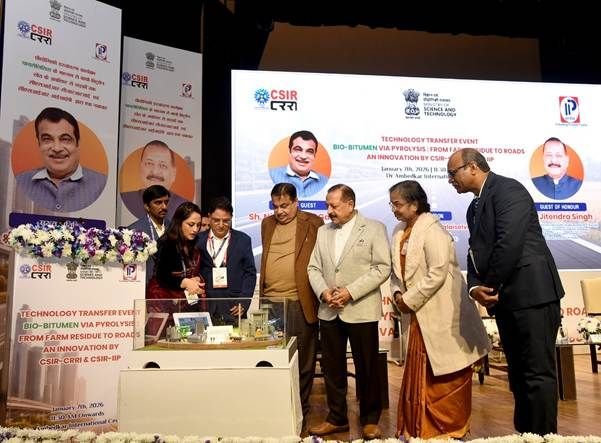
India’s push towards sustainable infrastructure has received a major boost with the Council of Scientific and Industrial Research (CSIR) transferring its indigenous bio-bitumen technology for large-scale industrial adoption. The innovation is expected to reshape the country’s road construction sector by offering an eco-friendly alternative to conventional petroleum-based bitumen.
Developed jointly by CSIR–Central Road Research Institute (CRRI) and CSIR–Indian Institute of Petroleum (IIP), the technology uses agricultural residue and other lignocellulosic biomass through an advanced thermochemical conversion process. The result is bio-bitumen, a renewable material that can be used for the construction of durable and efficient tar roads.
This development comes at a crucial time when India is focusing on green infrastructure and low-carbon construction practices. By converting crop residue into valuable road-building material, the technology directly addresses two major challenges: stubble burning and dependence on imported petroleum products. Crop burning has long been a key contributor to air pollution in northern India, especially during winter months.
Officials said the new technology also creates an economic opportunity for farmers, as agricultural waste that was once discarded can now become a source of additional income. This links the agriculture sector with infrastructure development in a meaningful way, supporting the vision of Atmanirbhar Bharat and the circular economy.
The bio-bitumen has reportedly demonstrated performance comparable to traditional bitumen in terms of durability, bonding strength, and compatibility with existing road construction processes. This makes it suitable for adoption in national highways, urban roads, and other infrastructure projects under the Ministry of Road Transport and Highways.
Industry experts believe the transfer of this technology from laboratory research to commercial application marks a significant milestone for India’s infrastructure sector. With growing emphasis on sustainable construction materials, CSIR’s innovation is likely to accelerate the use of green technologies in future road projects across the country.
- Atmanirbhar Bharat
- bio-bitumen
- Build Watch News
- Circular economy
- construction innovation
- crop residue
- CRRI
- CSIR
- eco-friendly bitumen
- Green construction
- green roads
- IIP
- India Roads
- Indian infrastructure
- Infrastructure news
- low carbon roads
- national highways
- road construction
- road sector
- road technology
- stubble burning
- sustainable infrastructure
- sustainable roads
- tar road material
- thermochemical conversion






Related Articles

JSW Cement to Merge With Shiva Cement, Creating Unified Cement Platform
JSW Cement has proposed merging with listed subsidiary Shiva Cement to create...
Ramco Cements Raises Jayanthipuram Clinker Capacity to 5.62 MTPA
Ramco Cements has completed de-bottlenecking at its Jayanthipuram plant in Andhra Pradesh,...

BEML Unveils India’s First Indigenous 60-Ton Electric Dump Truck BH60-EV
BEML has unveiled the BH60-EV, India’s first indigenous 60-ton electric dump truck,...



Prestige Estates Projects launches two Bengaluru housing projects with ₹2,850 crore revenue potential
Prestige Estates Projects has launched two new housing projects in Bengaluru with...

Leave a comment