




Piyush Goyal Warns EU Steel Carbon Tax Could Raise Costs and Hurt Industry Competitiveness
 Samrita JosephOctober 23, 20262 Mins read
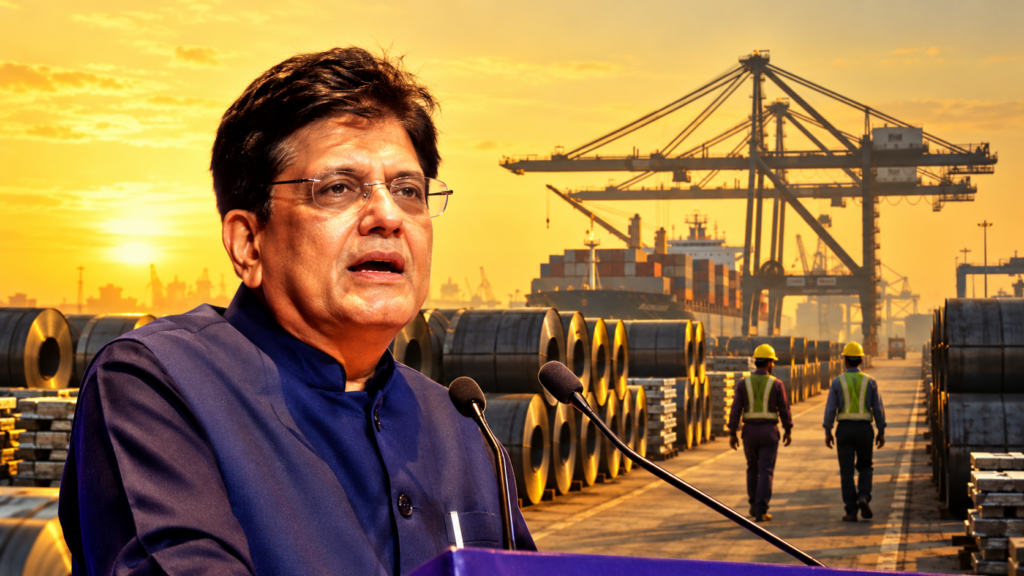
India’s Commerce and Industry Minister Piyush Goyal has criticised the European Union’s carbon tax on steel, warning that additional trade restrictions and regulatory costs could push up living expenses and weaken the competitiveness of European industries.
Speaking at the Berlin Global Dialogue in Germany on October 22, Goyal argued that the EU’s Carbon Border Adjustment Mechanism (CBAM), combined with import duties and other regulatory requirements, could make essential industrial materials more expensive. His comments come amid continuing concerns over the impact of Europe’s carbon-related trade policies on global steel markets and Indian exporters.
EU Carbon Tax Raises Concerns Over Industrial Costs
The CBAM mechanism requires importers of certain carbon-intensive products, including steel, aluminium and cement, to account for emissions generated during production. The policy is intended to address carbon emissions and reduce the risk of industries shifting production to countries with less stringent climate regulations.
However, Goyal argued that the additional costs associated with the mechanism could affect European manufacturers and consumers. He warned that higher material prices could increase the cost of infrastructure development, including ports, airports, highways, expressways and water supply networks.
Steel, aluminium and cement are essential materials for construction and industrial development. Any sustained increase in their prices could add pressure to project budgets, particularly for infrastructure-intensive sectors.
Goyal also cautioned that expanding regulatory restrictions could invite retaliatory measures from trading partners, potentially creating additional challenges for European businesses operating in international markets.
Implications for Indian Steel Exporters
For India, the debate has implications beyond Europe’s domestic industrial costs. Indian steel manufacturers exporting to the European market could face additional reporting, emissions verification and compliance requirements under CBAM.
These obligations may increase administrative expenses and affect the price competitiveness of Indian products, depending on their emissions intensity and the applicable carbon costs. Exporters will need to monitor the mechanism’s requirements closely as they assess market access, production costs and decarbonisation investments.
India has consistently raised concerns about the potential trade implications of carbon-related border measures, particularly for developing economies whose industries are working to reduce emissions while maintaining international competitiveness.
A Wider Challenge for Global Trade
Goyal’s remarks highlight the growing intersection between climate policy, industrial competitiveness and international trade. Governments are increasingly using environmental regulations to influence production and imports, while manufacturers must balance emissions reduction with cost efficiency.
The long-term impact of CBAM will depend on implementation, carbon pricing, compliance requirements and how trading partners respond. For steel producers, exporters and construction companies, the issue is becoming an important factor in decisions involving investment, sourcing and international expansion.
As India strengthens its industrial base and seeks to expand exports, the evolving EU carbon framework will remain an important consideration for businesses connected to global steel and construction supply chains.
- aluminium industry
- BuildWatch News
- Carbon Border Adjustment Mechanism
- Carbon Border Tax
- carbon compliance
- Carbon Emissions
- CBAM
- cement industry
- climate trade policy
- construction industry
- EU carbon tax
- European Union steel policy
- Global Steel Market
- India EU trade
- Indian steel exporters
- Indian Steel Industry
- industrial competitiveness
- infrastructure costs
- international trade
- Piyush Goyal
- steel exports from India
- steel industry news
- steel manufacturing
- Steel Prices
- Steel Trade




Related Articles

Bhartiya Urban, Alpine Plan ₹1,000 Crore-Plus Nikoo Homes 9 Alpine Project in North Bengaluru
Bhartiya Urban and Alpine are developing Nikoo Homes 9 Alpine, a ₹1,000...
Jindal Stainless Q2 Net Profit Rises 11% to ₹898 Crore, Revenue Grows 18%
Jindal Stainless reported an 11% rise in Q2 FY27 net profit to...

Havells India Q2 Net Profit Rises to ₹353 Crore as Revenue Jumps 34%
Havells India reported a 34.3% year-on-year rise in standalone revenue to ₹6,400...



Tamil Nadu Reconstitutes TNRERA, Appoints K. Phanindra Reddy as Chairperson
Tamil Nadu has reconstituted TNRERA, appointing retired IAS officer K. Phanindra Reddy...

Leave a comment