




Tvasta Unveils Vela, India’s First 3D-Printed Resort Pod
 Samrita JosephSeptember 3, 20262 Mins read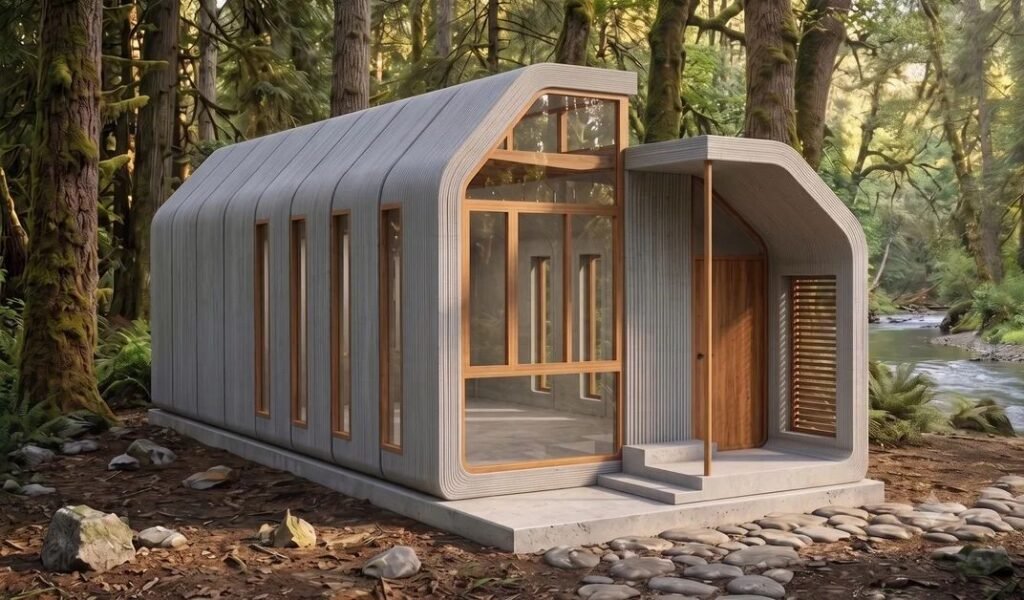
Tvasta, the construction-technology company founded at IIT-Madras, is taking its 3D-printing technology into the hospitality sector with Vela, a 3D-printed concrete resort pod designed to combine off-site manufacturing with rapid on-site installation.
The company began its journey in 2016 with a focus on applying deep-tech innovation to civil construction. In 2020, it unveiled what it describes as India’s first 3D-printed house, turning its research capabilities into a commercial construction technology platform.
Vela represents a further step in that evolution. Rather than printing an entire building at the project site, the resort pod is built largely in a controlled factory environment and assembled at its final destination.
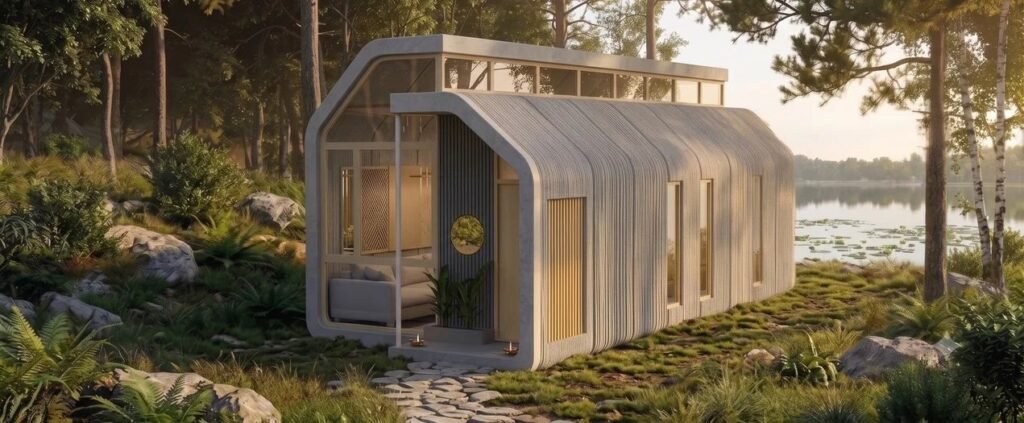
The pod uses 17 printed concrete panels to create an asymmetric vaulted shell. A continuous northern clerestory is designed to bring daylight through the length of the space, while glazing provides views in multiple directions.
The accommodation is planned as a compact hospitality unit, comprising one bedroom, one bathroom, an open living and kitchenette area, and a private deck.
A major part of Tvasta’s proposition is the reduction of conventional site activity. Around 75% of the pod is printed, serviced and finished off-site, while the remaining 25% is assembled at the project location.
Factory work includes printing and reinforcing the panels, plastering and painting, installing conduits and electrical systems, completing mechanical, electrical and plumbing fittings, and preparing doors, windows and furniture. Once cured and quality-checked, the components are packed and transported to the site.
According to the company’s stated installation process, on-site work can be completed in about seven days, covering panel erection, joint grouting, MEP connections, glazing, lighting, finishing and furniture placement.
Tvasta says the overall timeline from order to handover is around nine weeks, depending on the selected configuration.
Vela is also designed around different landscape settings. The company offers shell patterns intended for coastal, mountain and forest environments, allowing the external printed surface to become part of the architectural character of the location.
The commercial offering currently starts at ₹23.5 lakh for the Bare Shell version, while the furnished model starts at ₹29.5 lakh. A customised “Suit to Fit” option is available on request. The indicative pricing applies to sites within roughly 150 km of Chennai, Mumbai and Roorkee, with taxes, transportation and foundation costs additional depending on the site.
The development highlights how construction 3D printing is moving from experimental demonstrations towards applications where speed, repeatability and controlled manufacturing can provide practical advantages.
For resort operators, the approach could be particularly relevant where construction needs to be completed with limited disruption to an operating property or where individual accommodation units need to be added relatively quickly.
With Vela, Tvasta is effectively positioning 3D-printed concrete not simply as an alternative construction technique, but as a manufactured hospitality product that can be transported, assembled and customised for different environments.
- 3D printed concrete
- 3D printed construction
- 3D printed house India
- 3D printed resort pod
- 3D printing India
- concrete 3D printing
- construction innovation
- construction tech
- construction technology India
- deep tech construction
- future of construction
- hospitality technology
- IIT Madras startup
- Indian construction technology
- modular construction India
- prefab resort pod
- prefabricated construction
- proptech India
- resort construction
- Resort development
- smart construction
- Sustainable construction
- Tvasta
- Tvasta 3D printing
- Vela resort pod





Related Articles
Zydex Paints Enters India’s Retail Market with Three New Products, Targets 1% Share in Three Years
Zydex Paints has entered India’s consumer retail paints market with NIVO, DRIO...

Andhra Pradesh Plans ₹1,700 Crore Waterway Corridor Linking Muktyala with Machilipatnam Port
Andhra Pradesh has invited tenders for a 168-km navigation corridor linking Muktyala...
Awfis Space Solutions Revenue Rises 27% to ₹425 Crore in Q1 FY27
Awfis Space Solutions reported 27% revenue growth to ₹425 crore in the...



India Cements Q2 FY27 EBITDA Rises 34.3% to ₹148 Crore as Sales Volume Grows
India Cements, a subsidiary of UltraTech Cement under the Aditya Birla Group,...

Leave a comment