




Railways Cut Freight Rates to Boost Bulk Cement Transport
 Samrita JosephFebruary 9, 20261 Mins read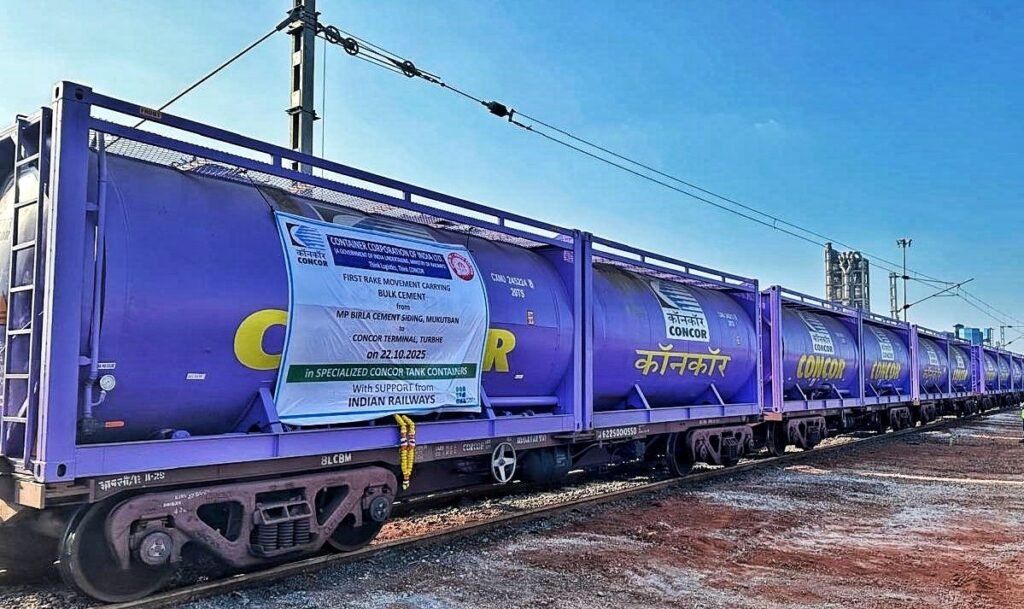
Indian Railways has taken a significant step to strengthen bulk cement logistics by revising its freight pricing structure, aiming to shift more cargo from road to rail. By lowering freight charges to 85 paise per gross tonne kilometre, the national transporter has made rail-based movement of bulk cement in tank containers more cost-effective and attractive for cement manufacturers across the country.
The revised tariff replaces the earlier rate of 90 paise per gross tonne kilometre and is accompanied by incentives for empty return movements of tank containers to the originating terminals. This change addresses one of the long-standing concerns of cement producers, who found previous charging mechanisms uneconomical and restrictive for large-scale bulk movement.
As a result of the new pricing model, several cement companies have begun approaching logistics operators for transporting bulk cement through tank containers. To support this growing demand, dedicated facilities are being developed at key terminals, including the installation of silos for efficient handling and temporary storage of bulk cement. These measures are expected to reduce handling losses and improve turnaround time compared to conventional bagged cement transportation.
The shift towards rail-based bulk cement movement is also expected to bring broader economic and environmental benefits. Lower dependence on road transport will help reduce overall fuel consumption, ease highway congestion, and cut carbon emissions associated with long-haul cement logistics. For cement manufacturers, the transition offers lower freight costs, better supply chain predictability, and improved plant-to-market efficiency.
Earlier, freight for bulk cement was calculated on a per container basis with a graded discount on empty returns spread over several years. Industry feedback suggested that this structure discouraged modal shift from road to rail. The current reform simplifies pricing and creates a more balanced framework that benefits both the railways and cargo owners.
With infrastructure development and housing demand continuing to rise, cement movement is expected to grow steadily in the coming years. Indian Railways’ latest freight reform positions rail as a viable and sustainable alternative for bulk cement logistics, supporting efficiency, cost savings, and long-term environmental goals.
- bulk cement movement
- bulk cement transport
- Cement Distribution India
- cement freight cost
- Cement Industry India
- cement logistics
- cement market India
- Cement supply chain
- CONCOR logistics
- Construction Materials Transport
- freight tariff revision
- green transport India
- gross tonne kilometre
- GTKM freight
- Indian Railways
- infrastructure logistics
- logistics efficiency
- low carbon logistics
- rail cargo policy
- rail freight rates
- rail freight reform
- rail vs road transport
- railway freight news
- Sustainable Transport
- tank container transport



Related Articles

Bharat Future City Land Acquisition Picks Up Pace in Telangana
Land acquisition for the proposed Bharat Future City on the outskirts of...

Tata Steel Q3 FY26 Results: Net Profit Surges 723% to Rs 2,690 Crore
Tata Steel reported a sharp turnaround in the October–December quarter of FY26,...

Kerala Cabinet Clears Rs 600 Crore Land Acquisition for KSpace Aerospace Centre
The Kerala Cabinet has approved the acquisition of 60 acres of land...



Build Intec 2026 Showcases the Future of Construction at Coimbatore
Build Intec 2026, South India’s flagship construction expo, has been inaugurated at...

Leave a comment