



IISc and KMRL Join Hands to Transform Kochi’s Urban Mobility Landscape
 Samrita JosephFebruary 13, 20261 Mins read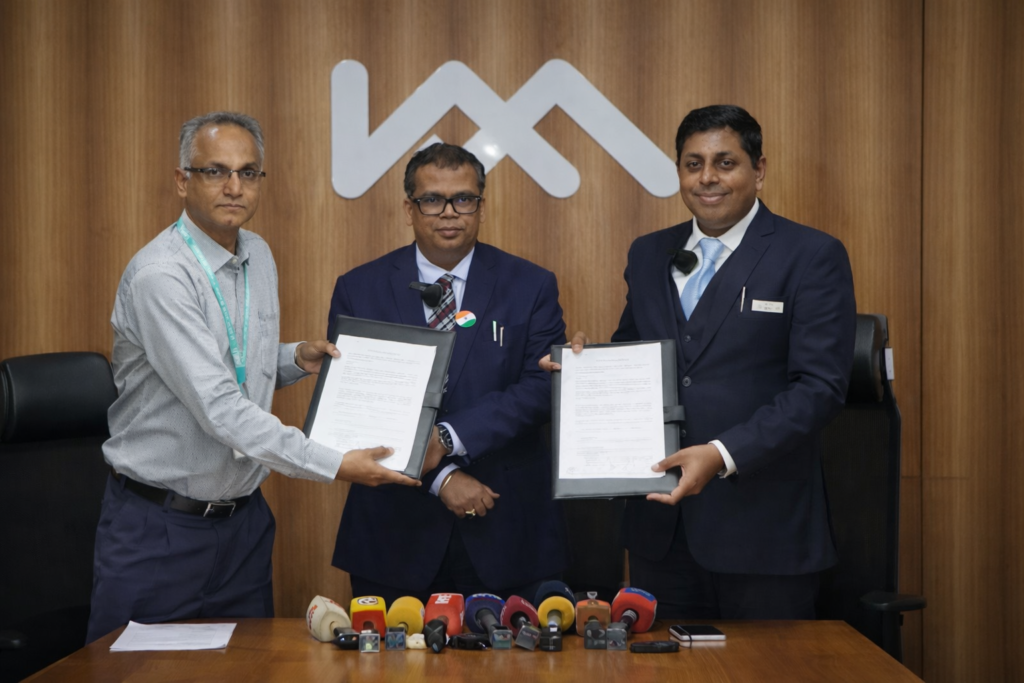
The Indian Institute of Science Bengaluru has signed a Memorandum of Understanding with Kochi Metro Rail Limited to collaborate on research and implementation in sustainable urban mobility and public transport systems. The partnership brings together academic depth and on ground execution to create practical solutions for one of India’s fastest evolving urban regions.
The agreement is designed to combine KMRL’s experience in operating Metro Rail, Kochi Water Metro and canal based transport initiatives with IISc’s strength in data driven and empirical research. By aligning operational insights with scientific modelling, the two institutions aim to build an integrated and resilient mobility framework for Kochi.
A key focus of the collaboration will be the application of emerging technologies such as artificial intelligence, Internet of Things, blockchain, simulation modelling and intelligent decision support systems. These tools will help evaluate accessibility, congestion, emissions and equity in urban transport planning while enabling evidence based decision making.
KMRL Managing Director Loknath Behra stated that mobility directly influences air quality, public health and overall quality of life. He noted that adopting a systems based and science led approach would help Kochi move towards becoming a more livable and climate resilient city. The diverse transport portfolio under KMRL provides a real world laboratory for innovation and interdisciplinary research.
Professor Ashish Verma of IISc highlighted that Kochi presents an ideal urban setting to demonstrate sustainable mobility solutions that can be replicated across Indian cities. Advanced simulation models developed by IISc will allow policymakers to test transport interventions virtually before implementation.
Under the MoU, both organisations will work on applied research projects, capacity building initiatives and student led studies. The long term goal is to promote greater use of public transport, walking and cycling while reducing dependence on private vehicles, setting a benchmark for sustainable urban mobility in India.
- AI in transport
- climate resilient cities
- data driven planning
- Green Mobility
- IISc
- Indian Institute of Science
- intelligent transport systems
- Kerala infrastructure
- KMRL
- Kochi infrastructure
- Kochi Metro Rail Limited
- Metro Rail Development
- mobility innovation
- mobility partnership
- multimodal transport
- public transport planning
- public transport systems
- simulation modelling
- Smart Cities India
- sustainable urban mobility
- transport policy India
- urban planning India
- urban sustainability
- urban transport research
- Water Metro





Related Articles

TNRERA holds developer responsible for project delay, rejects generic excuses
The Tamil Nadu Real Estate Regulatory Authority has held a developer accountable...
Puravankara to Launch 30 Projects Worth ₹55,000 Crore GDV Across South India and Mumbai
Puravankara Limited plans to launch 30 real estate projects over the next...
Centre Raises Commercial LPG Allocation to 70% to Support Steel, Auto and Textile Industries Amid Supply Disruption
The Centre has increased commercial LPG allocation by 20 per cent, taking...


Telangana approves ₹384.45 crore flyover and underpass project to ease Cyberabad traffic congestion
The Telangana government has cleared a ₹384.45 crore infrastructure project in Cyberabad,...

Leave a comment