





Domestic Steel Prices Plunge to Five-Year Low Amid Rising Imports and Weak Export Demand
 Samrita JosephOctober 27, 20251 Mins read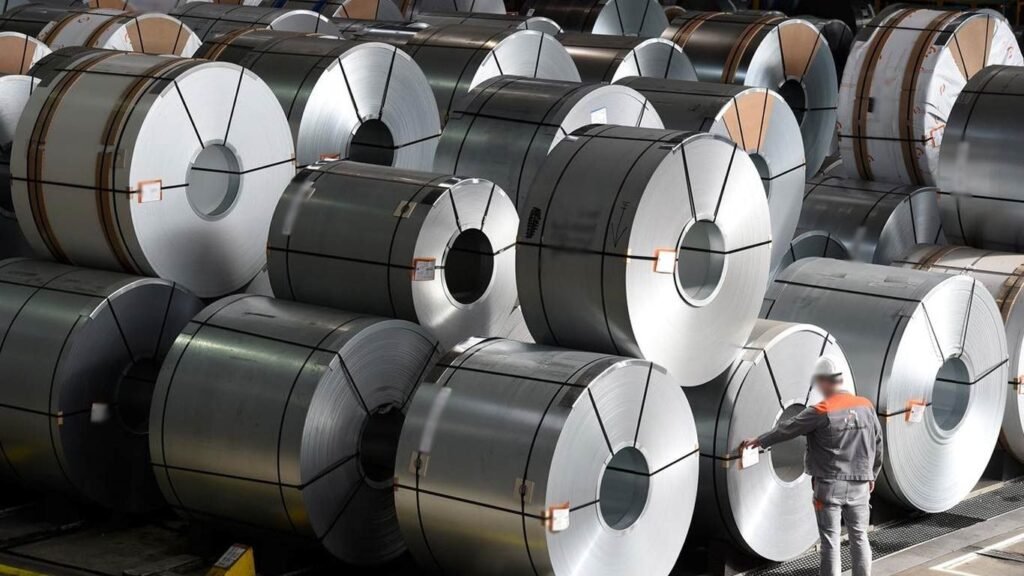
Domestic steel prices have fallen sharply to Rs 47,000–48,000 per tonne, marking a five-year low, as rising imports and weak export demand exert pressure on Indian mills. Hot rolled coil (HRC) is trading around Rs 47,150 per tonne, while rebar (TMT) is quoted between Rs 46,500–47,000 per tonne, levels last seen during the pandemic slowdown in 2020.
Market analysts attribute the decline to multiple factors. Global oversupply, aggressive export pushes from countries like China, and sustained import activity have contributed to the downward trend. Despite government measures to curb steel imports, India remains a net importer, with September 2025 seeing 0.79 million tonnes of finished steel brought into the country, up from 0.69 million tonnes in August.
Imports from Korea, Russia, and Indonesia surged, while shipments from China, Japan, Vietnam, Thailand, and Taiwan declined compared with September 2024. During the first half of FY26, inbound steel exceeded exports by 0.47 million tonnes, even as export volumes rose 40 percent to 4.43 million tonnes.
Interestingly, while steel prices have tumbled, raw material costs remain elevated. Iron ore continues to trade around Rs 4,800–5,000 per tonne, a one-year low, and coking coal is near USD 205 per tonne CFR, a one-month low. This mismatch is putting additional pressure on mill margins, particularly for smaller producers.
Taking note of the situation, the Ministry of Steel is holding an open house discussion today in New Delhi with industry stakeholders to address import-related concerns. The Reserve Bank of India has also highlighted the need for policy support to enhance the competitiveness of domestic steel production.
Looking ahead, market experts expect steel prices to remain subdued in the near term due to high inventories, soft demand, and seasonal weakness. Any further price corrections could prompt production adjustments in the coming months, as mills navigate high input costs and global market volatility.
- Coking Coal
- domestic steel
- export demand
- FY26 steel
- global steel supply
- HRC price
- import surge
- India steel market
- Indian Steel Industry
- iron ore price
- market trends
- New Delhi steel news
- raw material cost
- Steel Exports
- Steel Imports
- steel industry analysis
- steel industry news
- steel inventory
- Steel Market Forecast
- steel market update
- steel mills
- steel ministry
- Steel Prices
- Steel Production
- TMT price






Related Articles

HiLITE Group Begins ₹600 Crore Cyber Tower Project in Kozhikode, Targets 10,000 IT Jobs
HiLITE Group has started work on its ₹600 crore Cyber Tower at...

Saint-Gobain Plans ₹11,000 Crore India Investment Over Five Years, Tamil Nadu Gets ₹5,400 Crore
Saint-Gobain plans to invest ₹11,000 crore in India over five years, including...
NCL Industries Cement Production Rises 22% in Second Quarter of FY27
NCL Industries recorded 22% year-on-year growth in second-quarter cement production to 781,056...


Thoothukudi Port Gets ₹17,167 Crore Approval for Outer Harbour Project
The Union Cabinet has approved the ₹17,167-crore Outer Harbour Project at VO...

Leave a comment