


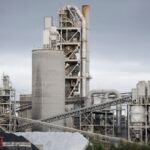


China’s “Supercool” Cement Promises Cooler Cities, Net-Negative Carbon Potential
 Kanmani ChokkalingamAugust 23, 20251 Mins read
In a breakthrough that could reshape construction materials, researchers at Southeast University, China, have developed a new type of cement that cools itself by reflecting sunlight instead of absorbing it. Tests show the cement can lower surface temperatures by nearly 10°F (5.4°C) during peak daytime heat.
The material, described in Science Advances, is engineered with “metasurfaces” that scatter sunlight and emit heat, achieving a solar reflectance of 96.2% and mid-infrared emissivity of 96%. In real-world trials, when outdoor temperatures reached 101.1°F (38.4°C), the cement’s surface remained 9.72°F cooler than its surroundings. By contrast, conventional cement surfaces rose by 59°F under the same conditions.
Beyond its cooling function, the cement retains high strength and durability. Profound tests of performance validated resistance to compressive forces, flexural forces, abrasive forces, and adhesive forces. All of the above contribute further to the evidence of the material durability against ultraviolet radiation, corrosive liquids, and freeze-thaw cycles for long-term applications in roofs and walls.
The innovation originates from the re-engineering of the chemical composition of clinker particles, which are the building blocks of cement, to favor the formation of reflective ettringite crystals. These fit together in a self-assembled way into a surface structure that scatters light and creates the supercooling effect of the cement.
Researchers went further to highlight the environmental prospects. A machine learning-based life cycle assessment indicated that this material could be net negative in carbon emissions, counteracting both urban heat and emissions.
Crucially, this becomes a very attractive option due to scalability and low cost, giving an advantage over other cooling materials that are more difficult to use. This makes it suitable for mass adoption in construction, from coatings to structural components.
Guo Lu, the study’s lead author, said the findings could mark a “turning point in climate response,” adding that applying cooling cement to urban infrastructure could significantly cut energy demand for air conditioning. “We transformed heavy, heat-storing cement into a climate-friendly material capable of reflecting sunlight and emitting heat,” Guo noted.
With cities worldwide grappling with rising heatwaves and energy costs, the Chinese team’s “supercool cement” could emerge as a game-changer, turning one of the world’s most used and carbon-intensive materials into part of the climate solution.
- Buildwatchnews
- carbon negative cement
- cement for hot cities
- cement reduces air conditioning
- cement technology breakthrough
- cement with metasurfaces
- China cement innovation
- climate friendly cement
- construction materials innovation
- cooling building materials
- eco-friendly cement
- energy saving construction
- future of cement
- green building materials
- heat reflective cement
- low carbon construction
- metasurface cement
- reflective ettringite cement
- Science Advances cement
- self cooling cement
- solar reflective cement
- Southeast University research
- supercool cement
- sustainable cement
- urban cooling solutions



Related Articles
Cement Companies May Attempt ₹5–20 Price Hike in October, Says Centrum Broking
Cement companies may attempt ₹5–20 per bag price hikes across most Indian...
Smartworks Secures ₹305 Crore in New Corporate Leasing Revenue
Smartworks has secured new corporate leasing engagements worth ₹305 crore in incremental...
Pidilite, South Korea’s Hwaseung Chemical Partner to Bring Advanced Footwear Adhesives to India
Pidilite Industries and South Korea’s Hwaseung Chemical have partnered to introduce globally...


India’s New Steel Policy Targets 600 Million Tonnes Capacity by 2047
India’s proposed new steel policy targets 600 million tonnes of steelmaking capacity...

Leave a comment